Their own paperwork
The government’s documents
The government’s version made the headlines. The government’s documents tell a different story.
The Judgment has been entered. The file is public. Dr. R Burton isn’t asking you to take his word for anything. Walk the paperwork with him — beat by beat, document by document.
Proof Index →Beat One — January 3, 2024
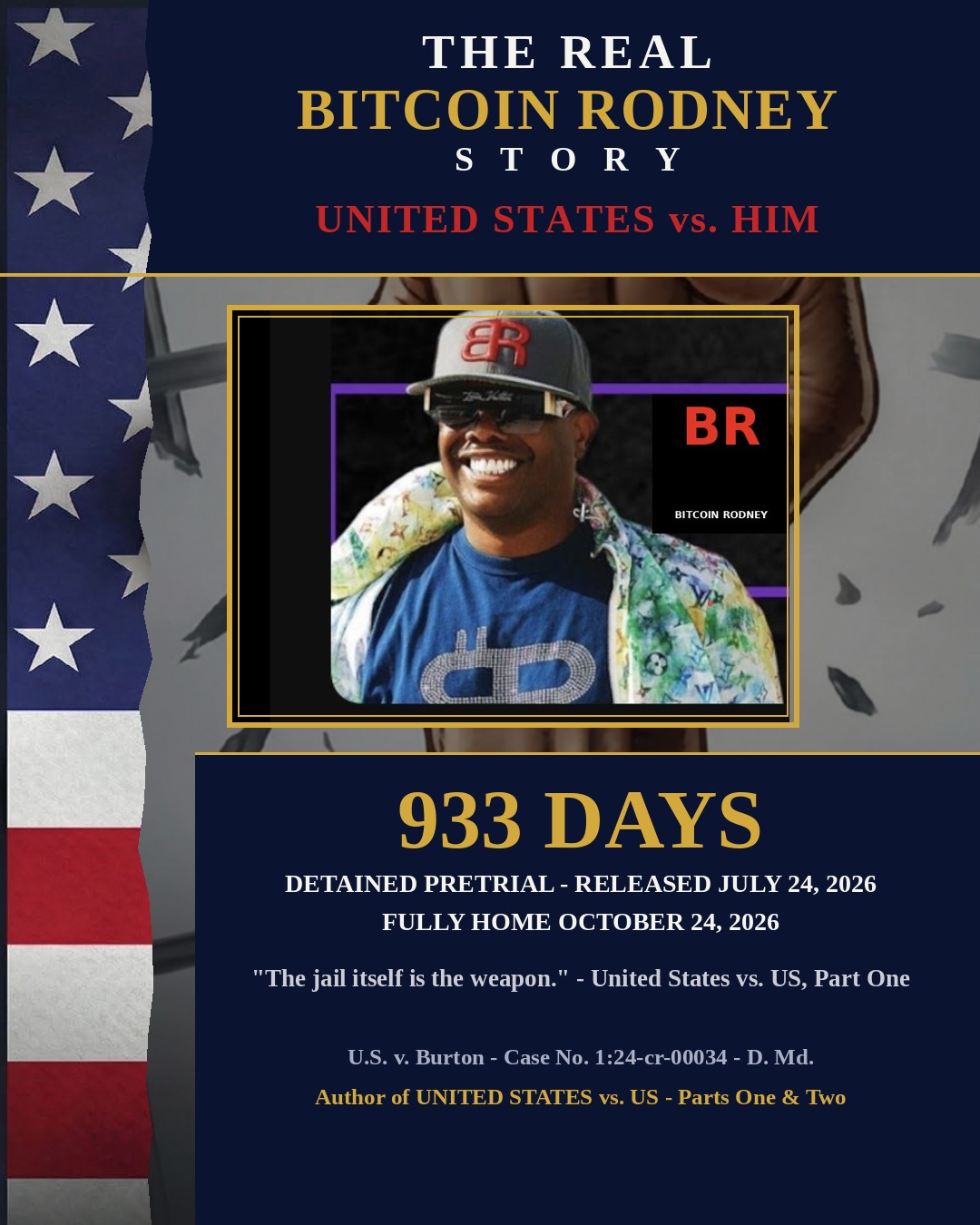
THE BANNER
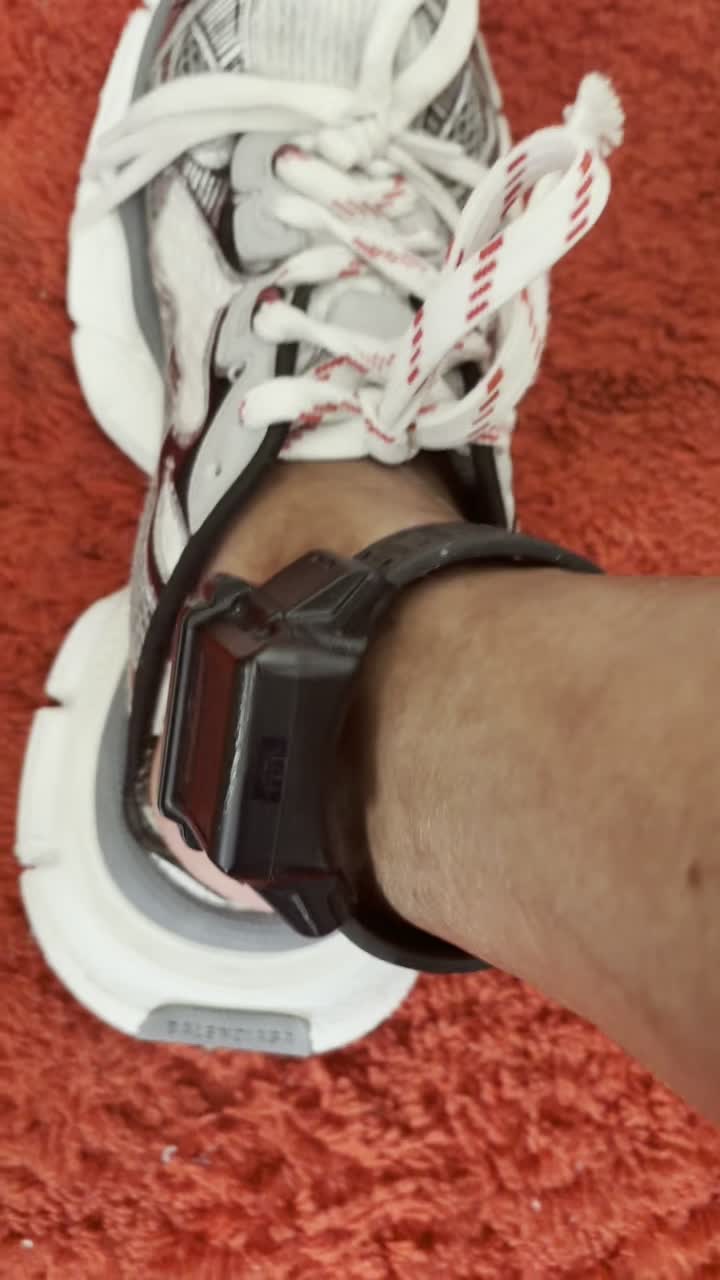
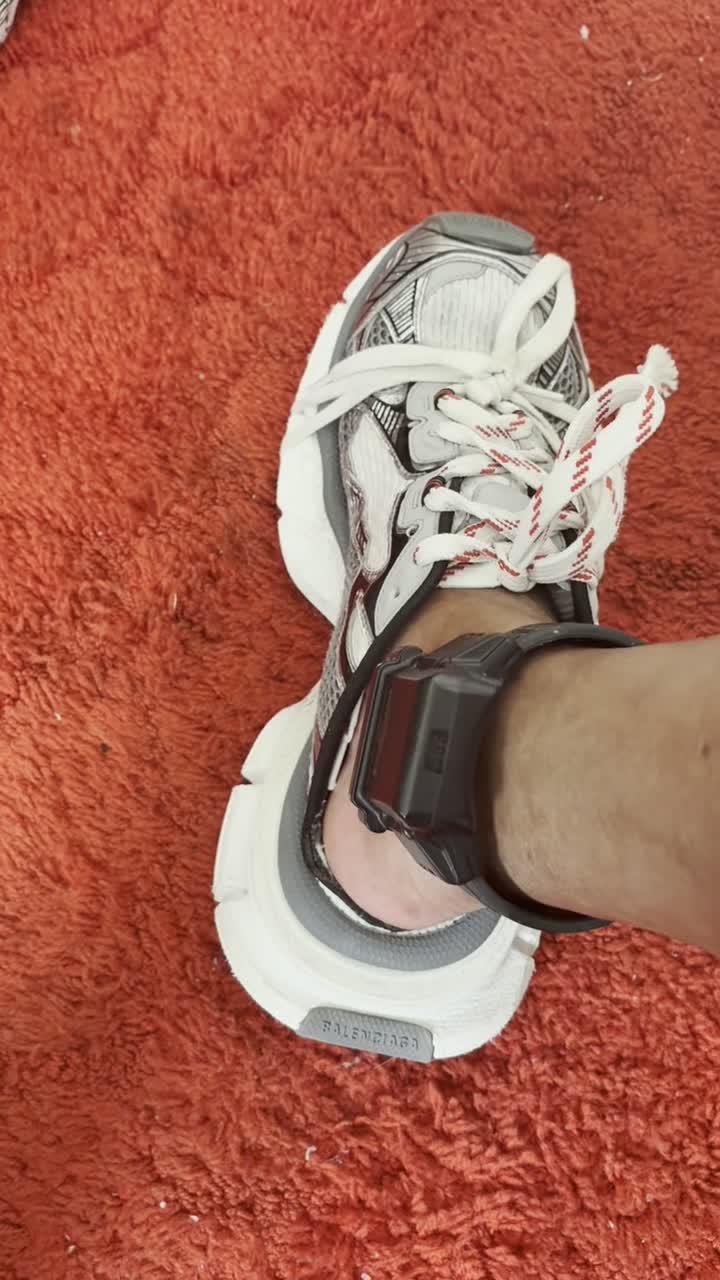
They took him at Miami International Airport on January 3, 2024.
At the January 24, 2024 detention hearing, the prosecution argued for detention. The court discussed Burton’s assets in assessing risk of flight. The original indictment later contained two licensing-related counts.
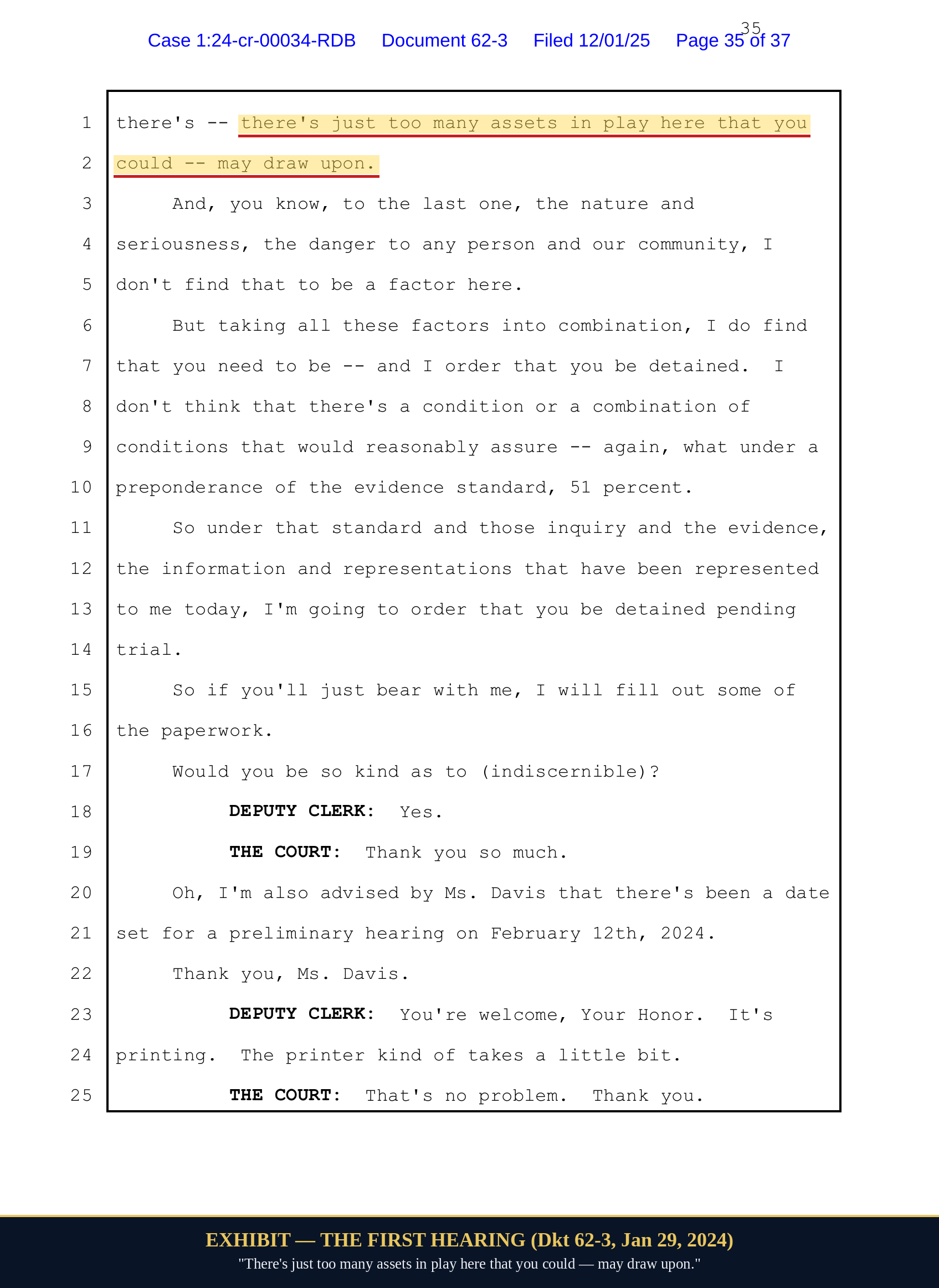
And how did the judge decide he was too dangerous to go home? Not the charges. The assets. Listen to the court’s own words about his yacht:
“You also have this yacht. And I concur that it may not get you to Dubai, but it certainly can get you out of the United States… there’s just too many assets in play here that you could — may draw upon.”— Judge Aslan, detention hearing, Jan. 24, 2024 (Dkt 62-3, Tr. 34–35)
Own it, and you’re a flight risk. Remember that — because before this story ends, getting rid of an asset gets argued as flight risk too.
Detention ordered. Day one of 933.
He would write down the theory of that day in the book he composed during his detention, United States vs. US:
“This isn’t a broken system… This is a designed system. It was built to produce exactly these results. It runs on coercion the way an engine runs on fuel.”— United States vs. US, Part One, Introduction
For the man processed into a cell before any conviction, the book has one cold word: “They become inventory.” (Part One, Ch. 1) — one of the unconvicted the book counts: “More than 470,000 Americans sit in jail right now who haven’t been found guilty of anything. They are legally innocent.” (Part One, Ch. 5)
Beat Two — The Charge Itself
WHAT “UNLICENSED MONEY TRANSMITTING” ACTUALLY MEANS
In nearly three years of headlines, nobody ever explained the charge. Here it is, in plain English.
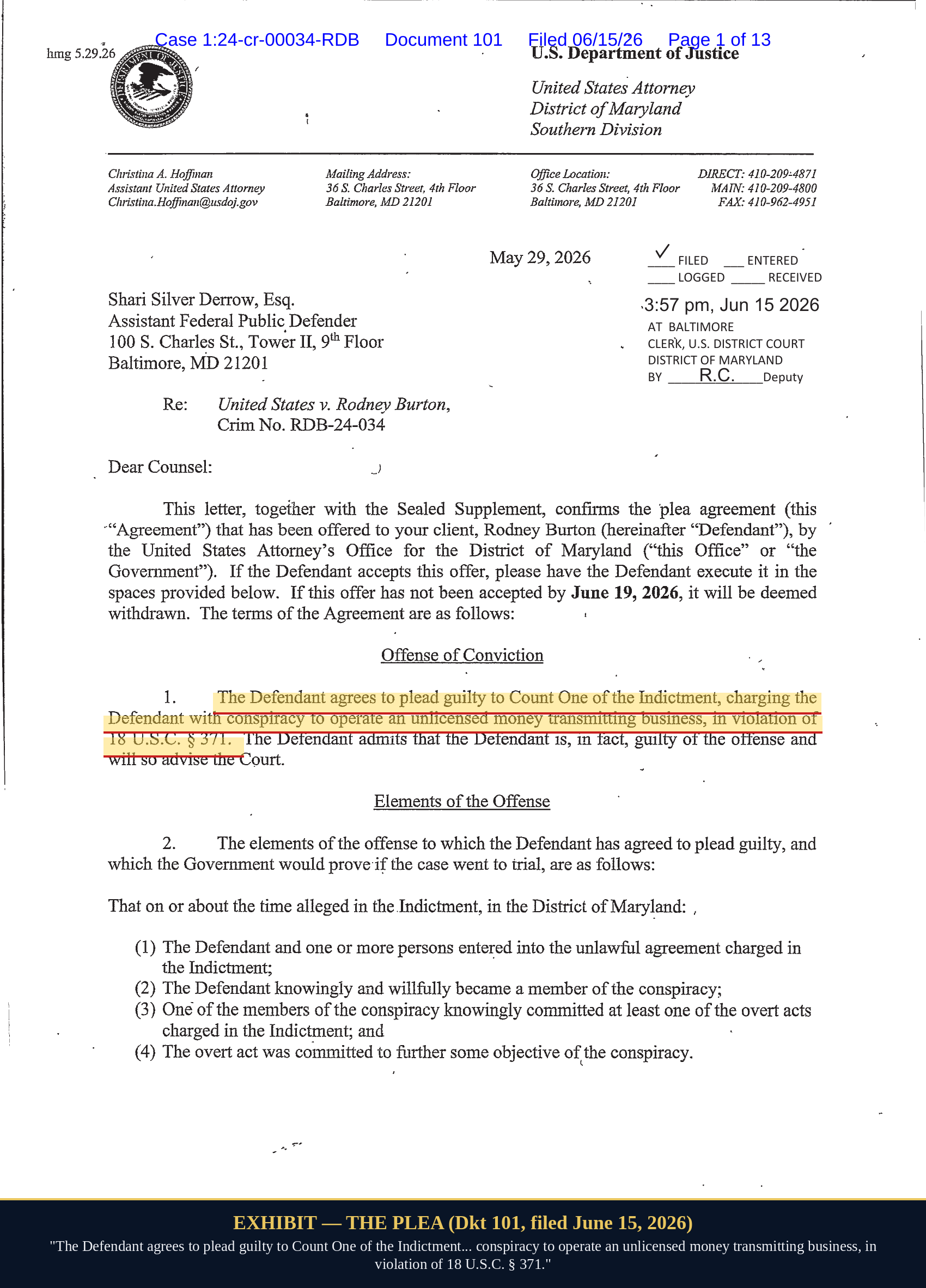
Section 1960 addresses unlicensed money transmitting. Burton’s June 15, 2026 plea was to Count One of the ORIGINAL indictment under 18 U.S.C. section 371 — conspiracy to operate an unlicensed money transmitting business. The filed plea agreement below identifies that count.
So what was Burton actually doing? His account — the same one he has given from the beginning: people who wanted into crypto came to him, and the normal channels were slow, so he completed the exchange for them himself — an internal transfer, or a transfer out of the wallet then in use. And the money detail at the center of the charge: moving value through that wallet cost fees at both ends, about three percent together. He passed that same three percent along. Not three percent added on top for himself — the three percent the transfer itself cost him, recouped.
“They charged me because I recouped the fee that was charged to me. That is exactly what they charged me for.”— Rodney Burton
His position has never changed: he did not run a money transmitting business. He helped individuals who asked for his help exchange their cash for crypto.
Keep this page in your hand. It is the one count this entire case finally came down to — on June 15, 2026, two and a half years later.
Burton’s book explains why a count like this one almost never meets a jury. Quoting the Supreme Court in Missouri v. Frye, it puts the design in one sentence:
“Criminal justice today is for the most part a system of pleas, not a system of trials.”— United States vs. US, Part One, Ch. 3, quoting Missouri v. Frye
The licensing count was never going to be tried; it was going to be pled, like 97 percent of them. And the machine, his book says, does not grade the charge — it grades the pressure: “The system doesn’t discriminate between the guilty and the innocent. It breaks whoever is most breakable.” (Part Two, Ch. 6)
Beat Three — April 7, 2025
THE MEMO THEY IGNORED
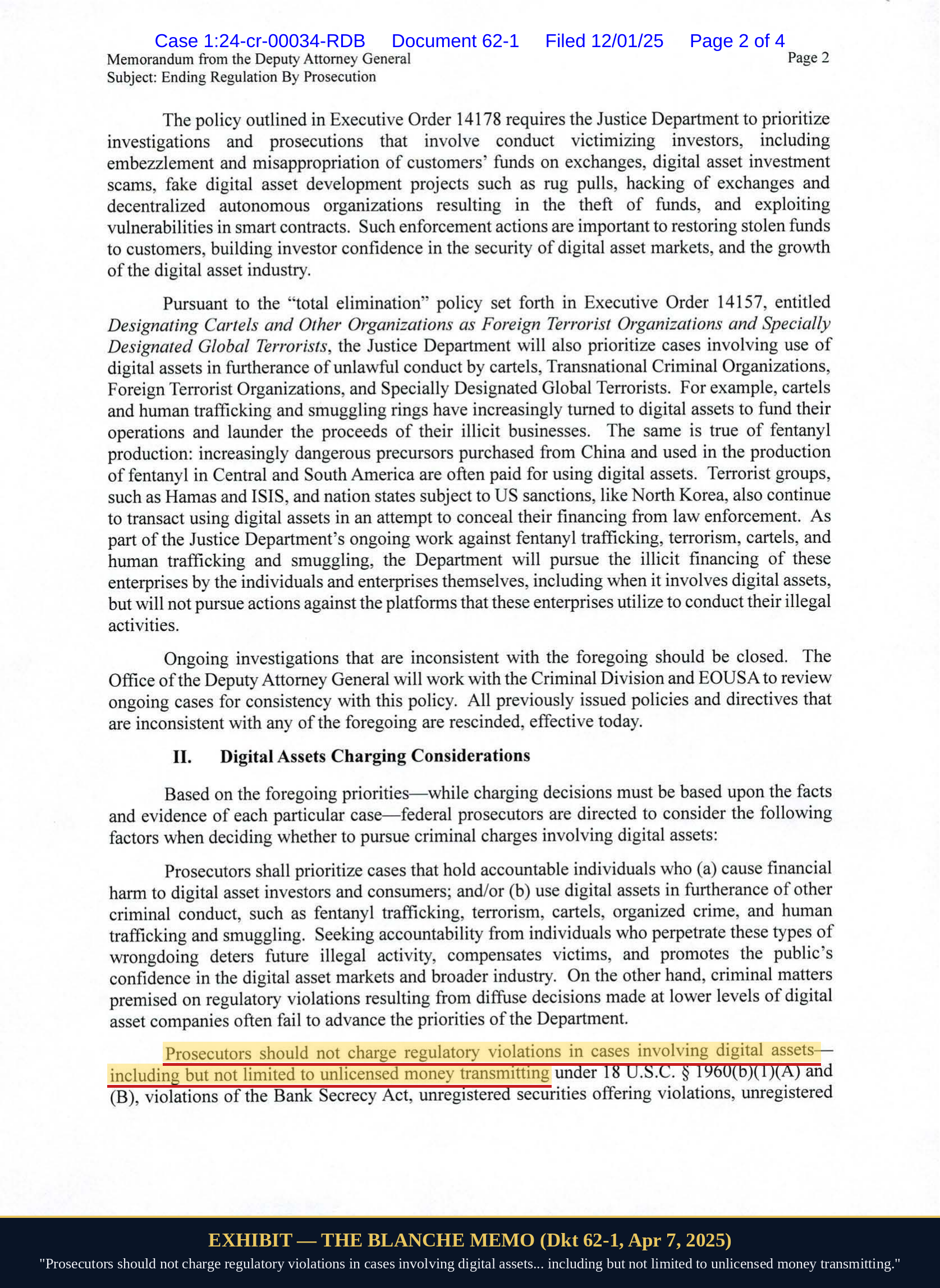
On April 7, 2025, the Deputy Attorney General of the United States sent a memo to the whole Justice Department. Title: “Ending Regulation by Prosecution.” Its directive:
“Prosecutors should not charge regulatory violations in cases involving digital assets — including but not limited to unlicensed money transmitting under 18 U.S.C. § 1960(b)(1)(A) and (B)”— The Blanche Memo (Dkt 62-1)
The memo addresses Section 1960(b)(1)(A) and (B), subject to its knowing-and-willful exception. Burton’s eventual plea was to conspiracy under section 371, not a conviction under Section 1960.
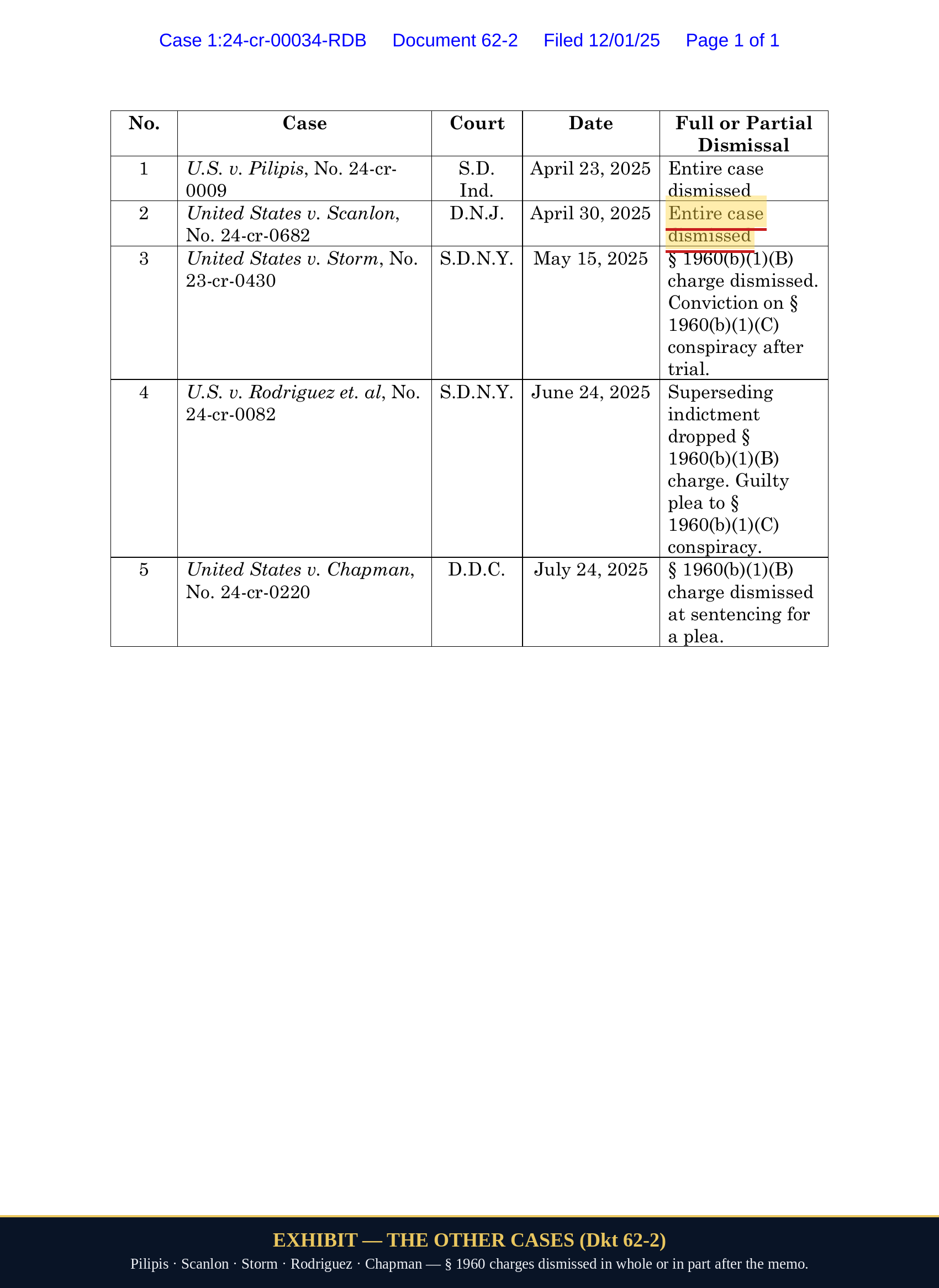
And the Department acted on it. Case after case like his started getting dismissed. His lawyers filed the memo and the chart of those dismissals and said it flat:
“Mr. Burton’s case belongs on this chart as the sixth dismissal.”— Defense memorandum (Dkt 62)
When a trial prosecutor on Burton’s own case asked to discuss the memo’s effect with the U.S. Attorney and his supervisor, the request was denied.
Burton’s case was not dismissed. He remained in a cell.
His book carries a passage for institutions that see the problem clearly — and proceed anyway. He wrote it about the Supreme Court. It fits a denied request just as well:
“The Court acknowledges the problem while blessing its continuation… The Constitution says one thing. the plea machine does another. The Court looks away.”— United States vs. US, Part One, Ch. 16
And for the man who makes the right argument to the wrong machine: “He was right about the arguments. What he underestimated was this machinery’s ability to protect itself.” (Part One, Ch. 14)
Beat Four — June 2022
THE GIVE-BACK
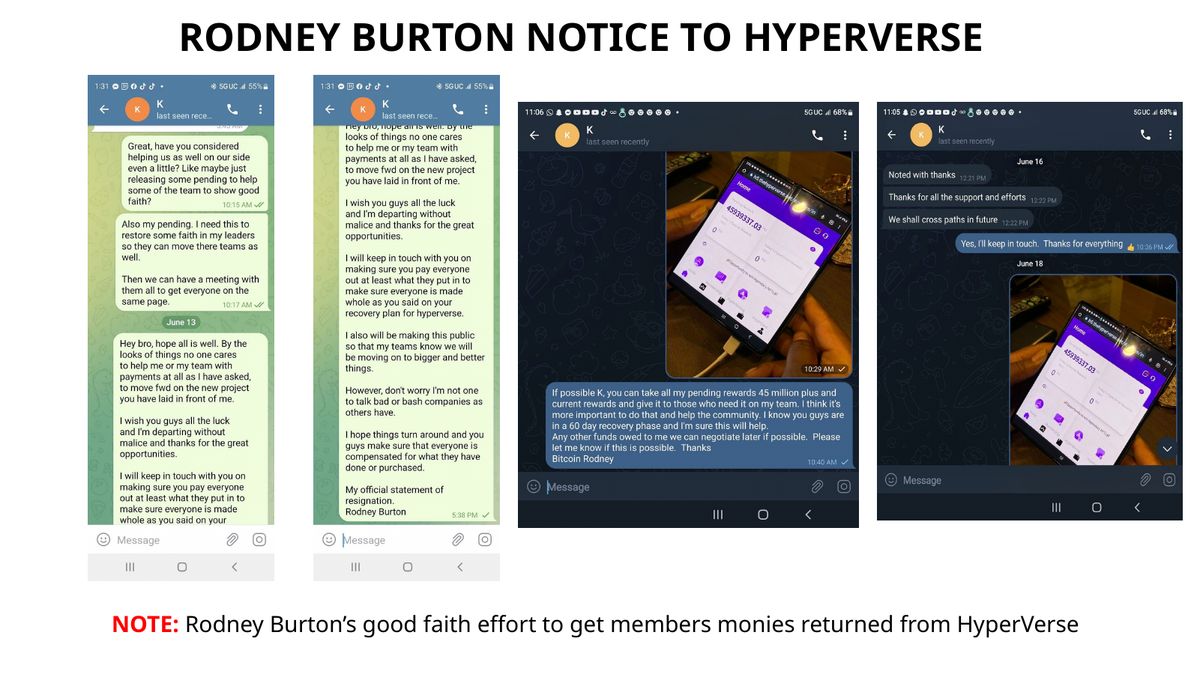
Back up — before the arrest, before the banner. In June 2022, Rodney Burton walked away from HyperFund on his own. On June 13, 2022, he resigned — and in the same breath he pressed the company to pay his team out at least what they had put in.
Five days later, on June 18, 2022, he sent this message to his company contact, and he meant every word of it:
“If possible K, you can take all my pending rewards 45 million plus and current rewards and give it to those who need it on my team. I think it’s more important to do that and help the community… Any other funds owed to me we can negotiate later if possible.”— Rodney Burton to “K,” June 18, 2022, 10:40 AM
In the same thread sits his own photograph of his account screen: $45 MILLION in pending rewards.
Burton’s account: he offered $45 MILLION in pending rewards to help his team. The DOJ page identifies Burton as a promoter and Sam Lee as an alleged co-founder.
The book he later wrote during his detention opens with a dedication to people like the team he gave that money back to. Its last line: “This book is your testimony.” — United States vs. US, Part One, Dedication.
Beat Five — February 12, 2026
THE PLEA THAT VANISHED
For months, the government’s own filings said it plain: “Burton rejected the plea offer.”
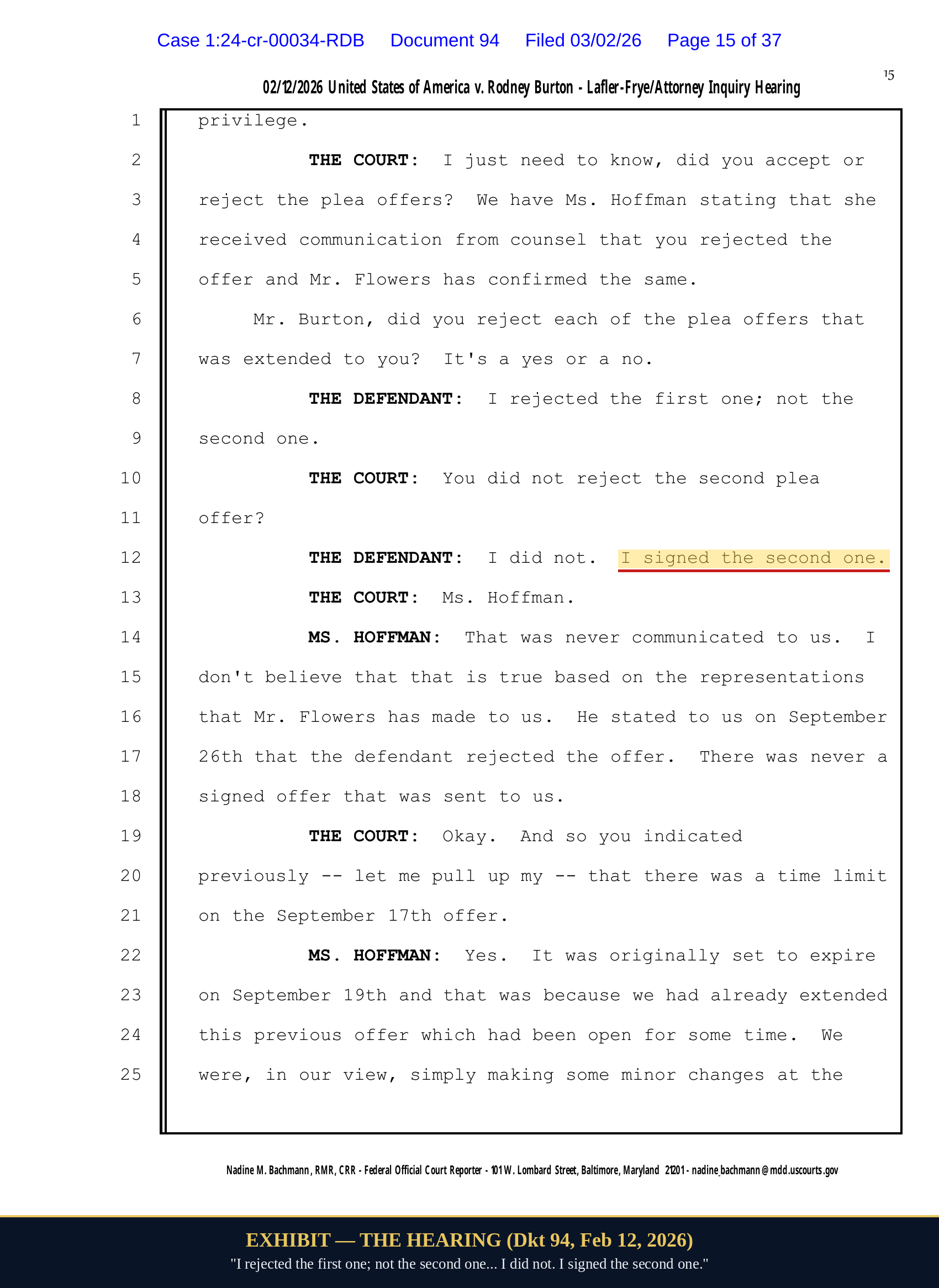
On February 12, 2026, that claim walked into a courtroom — and fell apart on the record. The judge questioned Burton directly about the two plea offers. His answer:
“I rejected the first one; not the second one… I did not. I signed the second one.”— Rodney Burton, under questioning (Dkt 94)
He signed it. So where did it go?
The prosecutor told the court a signed acceptance was never communicated to the government — because Burton’s own lawyer had told them on September 26, 2025, that his client had rejected it. Then that lawyer, Kobie Flowers, addressed the court himself: the rejection was done by email, by him as the lawyer. Burton did not send those emails.
“I did send those emails.”— Kobie Flowers, Burton’s own lawyer, on the record (Dkt 94)
And then — silence. Sixty-six days of it. The rejection his lawyer relayed went out on September 26, 2025; the next date that matters on the public record is December 1, 2025. A signed plea, a rejection its signer never sent, and sixty-six days of nothing.
At that same hearing, the government even misstated Burton’s own case to the court — describing the original indictment as “just one count.” It had two. His lawyer corrected it on the record, and the court thanked him. Days later, that lawyer was terminated, and a federal public defender took over.
And the government’s own telling of what came next? Their words:
“We later, of course, superseded.”— The prosecution, Feb. 12, 2026 (Dkt 94)
There is a reason this hearing carries the name it does. Frye and Lafler v. Cooper are the Supreme Court cases that say a plea killed by your own lawyer is a constitutional injury — the same cases Burton’s book teaches, in its chapter on the Court’s contradictions:
“In Missouri v. Frye (2012), the Court went further. Justice Kennedy, writing for the majority, acknowledged reality: ‘Criminal justice today is for the most part a system of pleas, not a system of trials.’”— United States vs. US, Part One, Ch. 16
His manual for defendants, Part Two, even carries a worksheet for weighing a plea offer — and its rule, in capital letters: “If you cannot check every box, DO NOT accept the plea.” (Appendix F) The worksheet assumes the signed offer reaches the government. Burton’s never did.
Beat Six — December 2025
THE STACK
On December 1, 2025, Burton asked the court to reopen his detention. His grounds were simple: his assets had diminished, so the original asset-based flight risk had dissipated; nearly two years served meant far less exposure remained; and the Blanche Memo had changed the ground under the whole case.
Nine days later, the answer came — not a hearing. An indictment.
On December 10, 2025, prosecutors filed a superseding indictment stacking eleven counts — wire-fraud conspiracy, wire fraud, seven money-laundering counts — onto a case that had stood at two licensing counts for 23 months.
Burton had already named this move in print, in the book he wrote during his detention:
“This is charge stacking: the practice of filing multiple charges for a single alleged act, multiplying the defendant’s exposure, creating use for plea negotiations.”— United States vs. US, Part One, Ch. 2
His walk-through of the play is colder still: “File ten counts for a single incident. Threaten decades of imprisonment. Make the plea offer look merciful by comparison.” (Part One, Ch. 6) His file: two counts became eleven.
Then watch what the stack was used for. The government argued against his release using the superseder’s own numbers — an anticipated Guidelines range of 135 to 168 months on the wire-fraud counts alone. The court treated the superseder as new, material information: it raised his statutory maximum to 35 years, made him “more motivated to flee,” and wiped out his prison-time and Blanche Memo arguments. Release denied, December 22, 2025.
“They told me to take the plea or they would stack the charges — and they stacked them.”— Rodney Burton
His book keeps the translation for language like that: “They didn’t call it coercion. They called it negotiation. They didn’t call it punishment. They called it discretion.” (Part One, Ch. 3)
The exposure that kept him in a cell was created by the prosecuting party, after he asked to be released. Hold that thought — because we will end this walk exactly where their own judge ended it.
First, you need to see where those 933 days were spent.
Beat Seven — 933 Days
INSIDE THE CHESAPEAKE DETENTION FACILITY
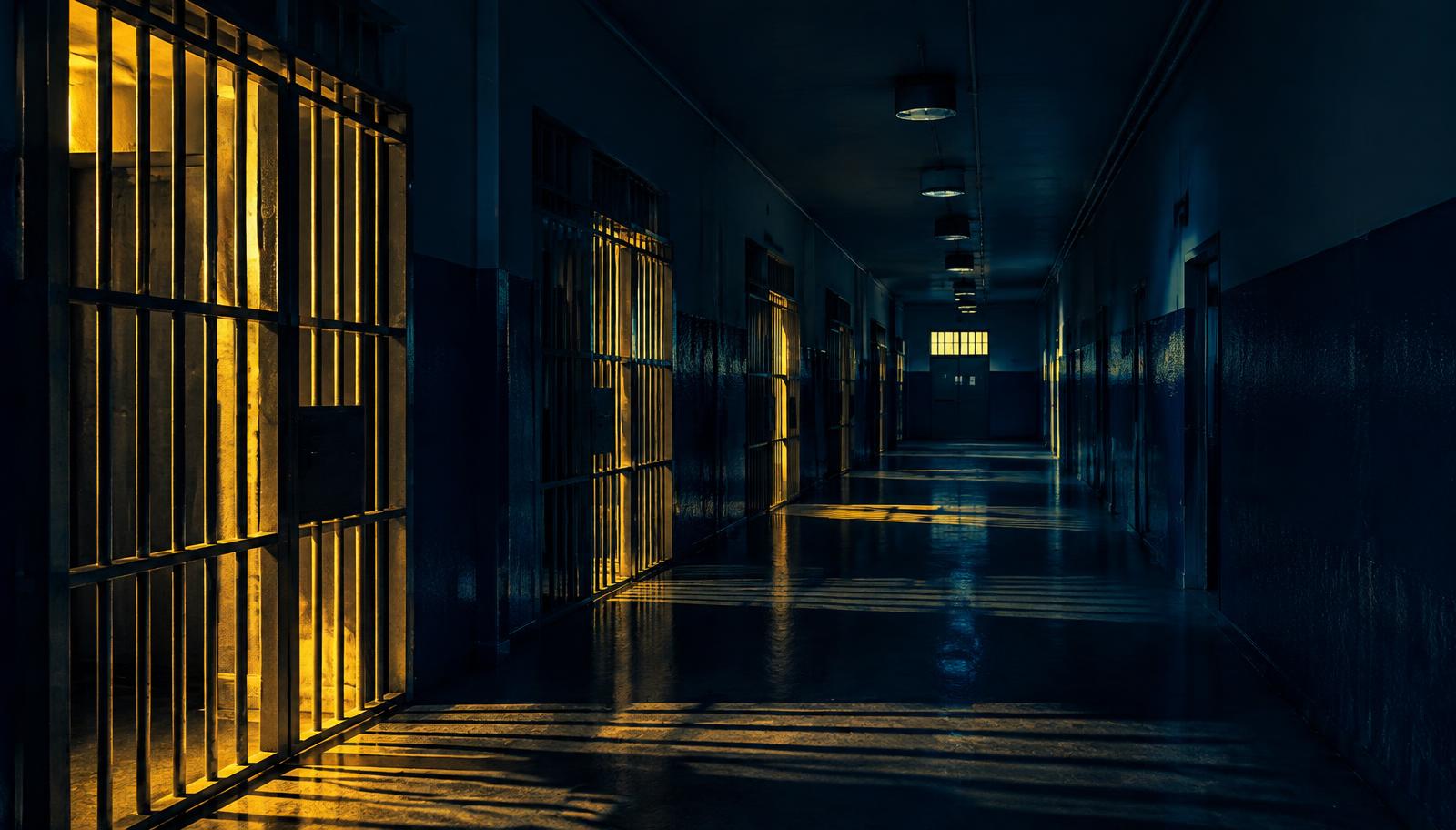
Every one of those 933 days, Burton sat in the Chesapeake Detention Facility in Baltimore — the maximum-security facility Maryland runs for federal pretrial detainees. Men and women who, in the eyes of the law, had not been convicted of the charges they were held on.
Burton’s book — written during those same years, about the pretrial system in general — states the purpose of detention like that in one sentence:
“This isn’t incarceration as punishment for crime. This is incarceration as coercion to extract guilty pleas. The jail itself is the weapon.”— United States vs. US, Part One, Ch. 5
Part Two says it to the detainee directly: “Pretrial detention is designed to break you. The overcrowding, the violence, the isolation, the medical neglect — none of it’s accidental. Every miserable day is pressure to plead guilty.” (Part Two, Ch. 8) Those are the book’s words about the system as a whole. What follows is this facility’s own documented record.
That facility’s own record is documented too. In Catchings v. Wilson, detainees alleged an uncontrolled COVID-19 outbreak had infected more than 200 detainees and employees in under a month, that single-person cells were double-celled, and that lockdowns amounted to indefinite solitary confinement. The case ended in a court-approved settlement on April 28, 2021 — a court had to order that facility to provide weekly testing, at least two hours a day out of a cell, guaranteed soap, disinfectant and masks, and expert inspections at least every 30 days.
Two hours a day out of a cell. Soap. That’s what it took a federal court order to guarantee.
And it did not end there. In December 2025 — while Burton was still held inside — the court-appointed monitor in Duvall v. Moore found the Baltimore pretrial detention system in noncompliance with six medical provisions, including documentation and review of vital signs and glucose results, timely response to critical lab results, and specialty-care referral logging. The full-compliance deadline was extended to June 2026.
State data show assaults on staff increased at the Chesapeake facility in FY2025. And when Burton arrived in January 2024, 13.7% of the facility’s staff positions stood vacant — a danger one of its own officers, Sgt. Dorian Johnson, had already named on the record:
“Every day we operate like this puts the people who do these jobs and those we supervise at risk of being seriously hurt.”— Sgt. Dorian Johnson, correctional officer at the facility, AFSCME Council 3 staffing report
933 days inside that. On a licensing case. Count them again — then ask what the charge was.
“The Constitution promises a trial. The jail promises to destroy you while you wait for one.” — United States vs. US, Part One, Ch. 5
Beat Eight — The Car
“LIQUIDATING ASSETS”
At Burton’s July 2024 detention hearing, the government argued he was liquidating assets by shipping a Rolls-Royce overseas. Flight risk, again.
One problem: Burton had been locked up since January. And CBP’s own records tell the rest. His lawyer’s filed memorandum answers the claim in one sentence:
“The Government’s assertion that Mr. Burton attempted to liquidate assets by shipping a Rolls Royce overseas is wrong.”— Defense memorandum (Dkt 62, n.19)
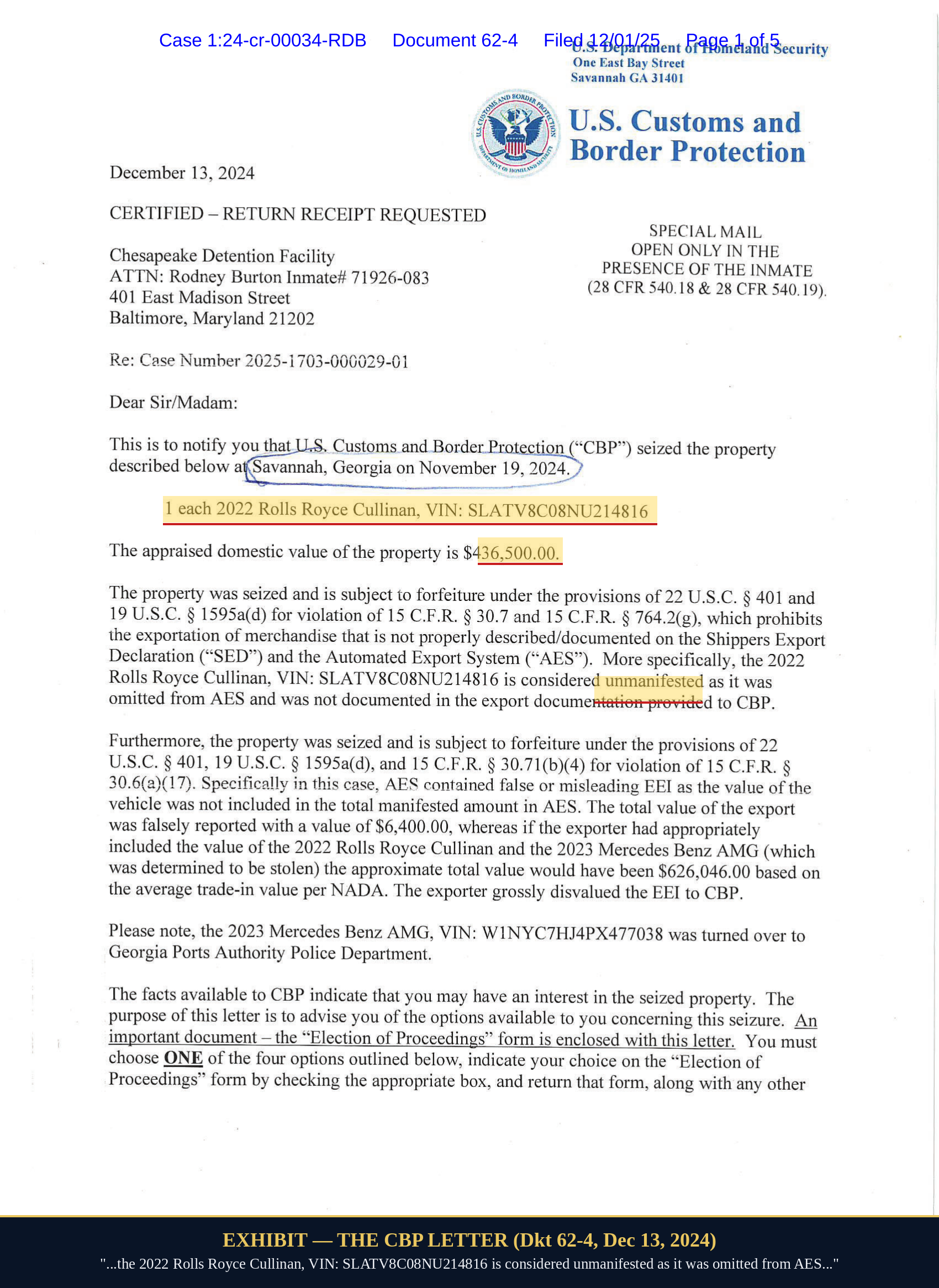
The CBP notification letter identifies a Rolls-Royce Cullinan appraised at $436,500 and describes it as “unmanifested.” The exhibit below is the filed notification, Dkt 62-4.
And the word “stolen” in that letter? It attaches to a different vehicle in the container — a Mercedes — which CBP turned over to the Georgia Ports Authority Police.
The car was never taken from Burton. He was in a cell. CBP picked it up at Savannah, out of an export container he never touched. The government’s own opinion (Dkt 79) records its position that the Cullinan was “the only asset it has seized.”
Own the assets — flight risk. An asset moves while you sit in a cage — flight risk. There was no version of this that let him go home.
His book describes the pretrial loss cascade in three flat sentences: “They lose their cars. Loan payments are missed. Repossession follows.” (Part One, Ch. 5) Burton’s cascade ran through a shipping container in Savannah. And the book’s two-tier line — “The rich get trials. The poor get pleas.” (Part One, Ch. 14) — ran backwards on him: he had the assets, and the machine used the assets themselves as the reason to keep him — then used an asset moving without him as the reason, too.
Beat Nine — June–July 2026
THE ENDING
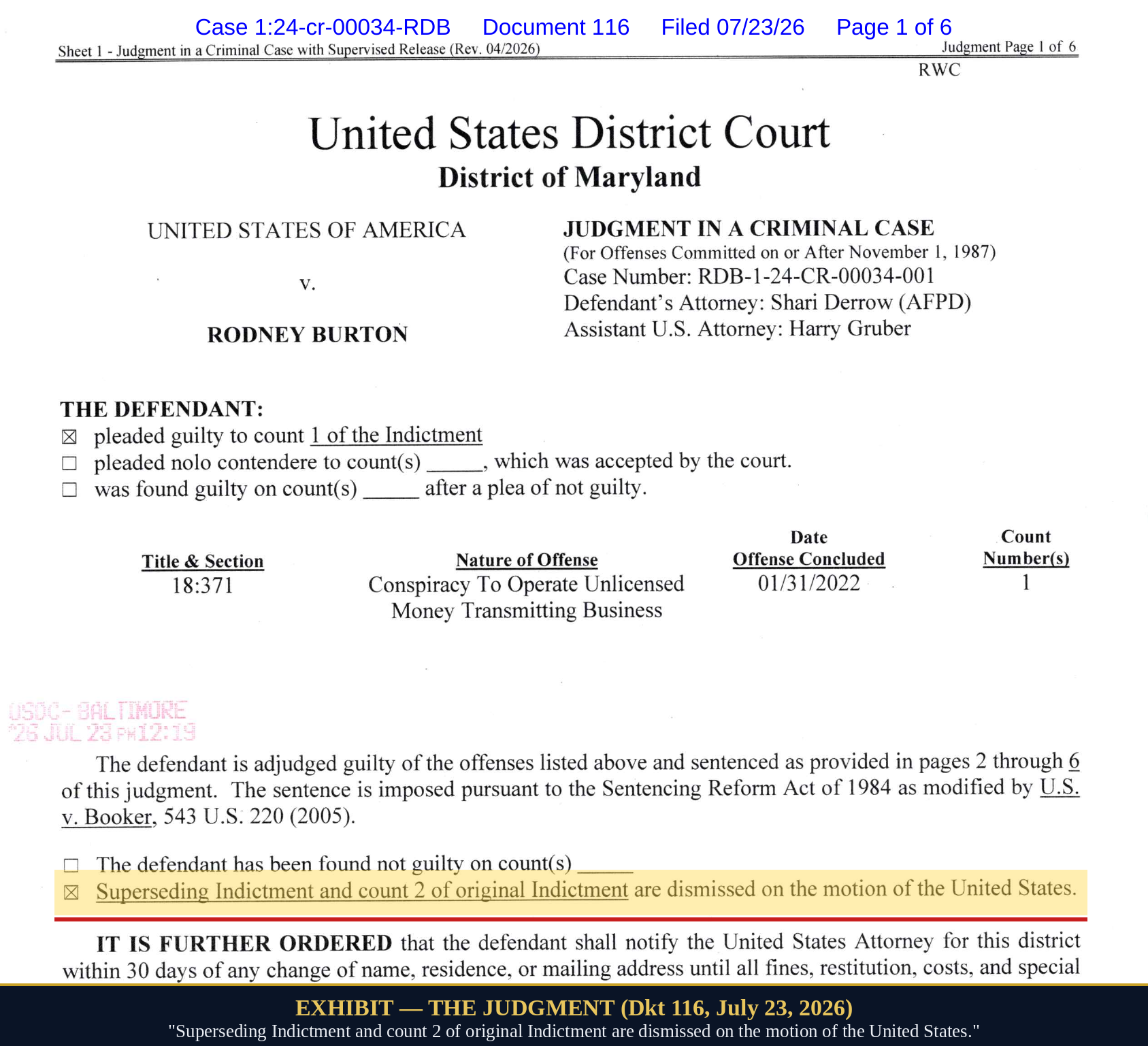
On June 15, 2026, Burton pleaded guilty to one count: Count 1 of the original February 2024 indictment — conspiracy to operate an unlicensed money transmitting business, 18 U.S.C. § 371. The licensing count. The one you held in your hand at Beat Two.
The Judgment, signed by Judge Richard D. Bennett on July 23, 2026, records the case’s disposition on its first page. Beneath the single count of conviction sits a checked box, in the court’s own words:
“Superseding Indictment and count 2 of original Indictment are dismissed on the motion of the United States.”— The Judgment (Dkt 116, p. 1)
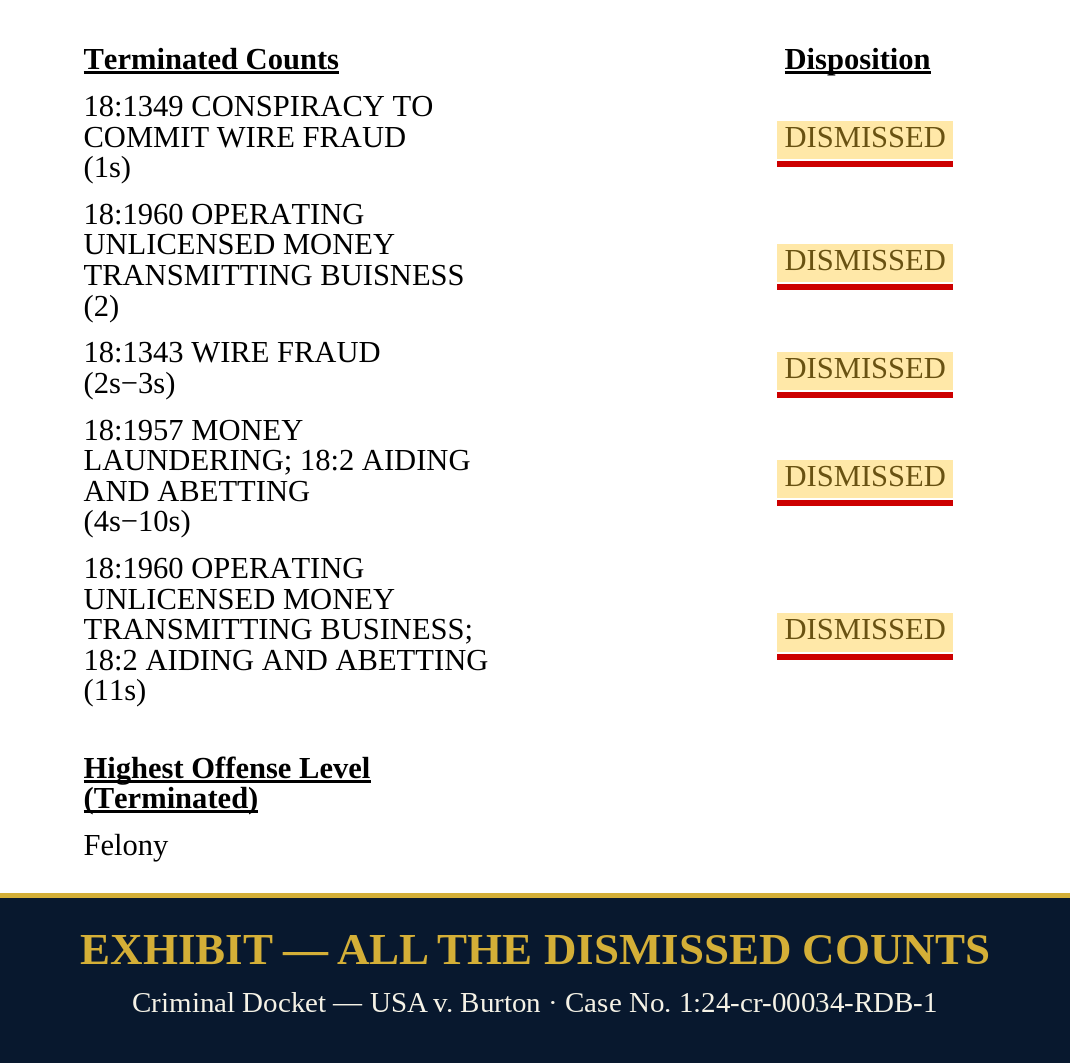
The entire superseding indictment and Count 2 of the original indictment were dismissed on the government’s own motion. Count One of the original indictment remained the count of conviction.
Burton was released July 24, 2026, after 933 days detained. House arrest ended Oct 24, 2026. Supervised release continues.
“Then their own judge signed a paper dismissing every last one of them. I lost 933 days. I lost a lot. But the record is mine now, and the record says what it says.”— Rodney Burton
His book’s conclusion names the whole case in one breath: “This is United States VS. US. The government against its own citizens. The system against the people it claims to protect.” (Part One, Conclusion)
And release, his manual warns, is not the end of it: “But release isn’t freedom. Not really.” (Part Two, Ch. 13) Supervised release continues after the walk-out. What the book promises the man who survives it: “You aren’t your worst moment. You aren’t your conviction. You aren’t your record number.” (Part Two, Ch. 14)
Beat Ten — The Question
MAKE IT MAKE SENSE
Read the dismissed counts again. Wire-fraud conspiracy. Wire fraud. Money laundering. The government spent years and a headline banner telling the world who Rodney Burton was supposed to be.
So ask the question his case leaves sitting in the middle of the room:
“If I was the bad guy as they said — if I did all of this stuff, and it was fraud like they tried so hard to prove — why didn’t they come seize any houses? Why didn’t they seize the bank accounts? Why didn’t they seize the crypto wallets? Why didn’t they take the yacht? Please explain that. Make it make sense.”— Rodney Burton
The government’s own filing supplies the uncomfortable part of the answer. In Dkt 79, it described the Cullinan — a car CBP picked up from an export container while Burton was already locked in a cell — as “the only asset it has seized.”
No houses. No bank accounts. No crypto wallets. No yacht. One car, taken out of a shipping container, in a case sold to the public under a fraud headline banner.
Make it make sense.
His book asks the same question from the other side of the glass: “What the process can’t survive is for enough people to see it clearly… For the question to become unavoidable: how can we call this justice?” (Part One, Ch. 14) And it knows what the machine does with an ending like his: “Then, this machinery records their surrender as proof of guilt.” (Part One, Ch. 6)
Beat Eleven — The Whole Record
116 ENTRIES
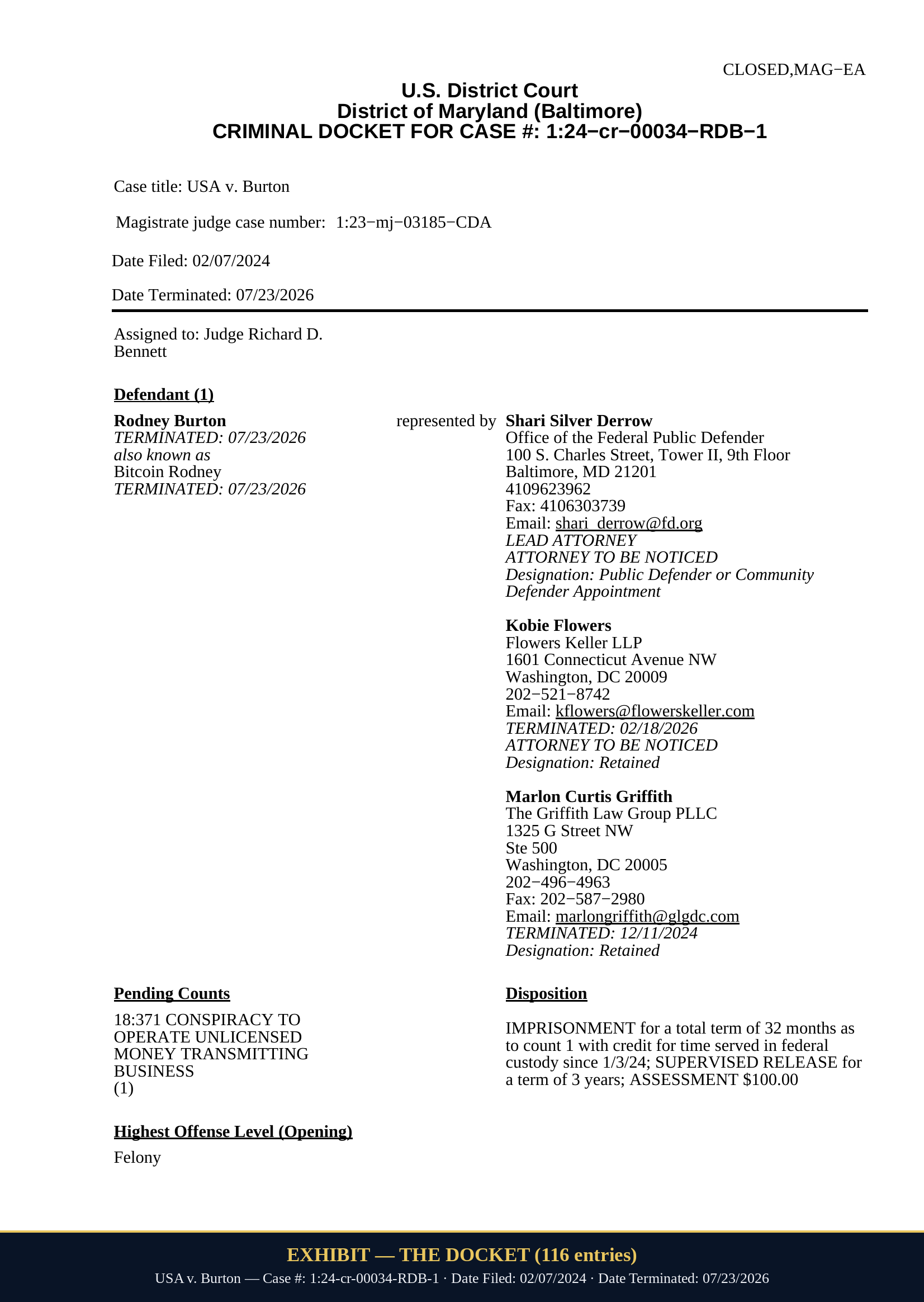
This is the docket — the court’s own table of contents for the entire case. Filed February 7, 2024. Terminated July 23, 2026. One hundred sixteen entries.
Read its summary of what was ever pending against him at the end: “18:371 CONSPIRACY TO OPERATE UNLICENSED MONEY TRANSMITTING BUSINESS (1).” One count. A licensing count.
It was there in black and white the whole time — underneath a headline banner.
The Chapter — His Account
THE CHAPTER HE COULDN’T WRITE
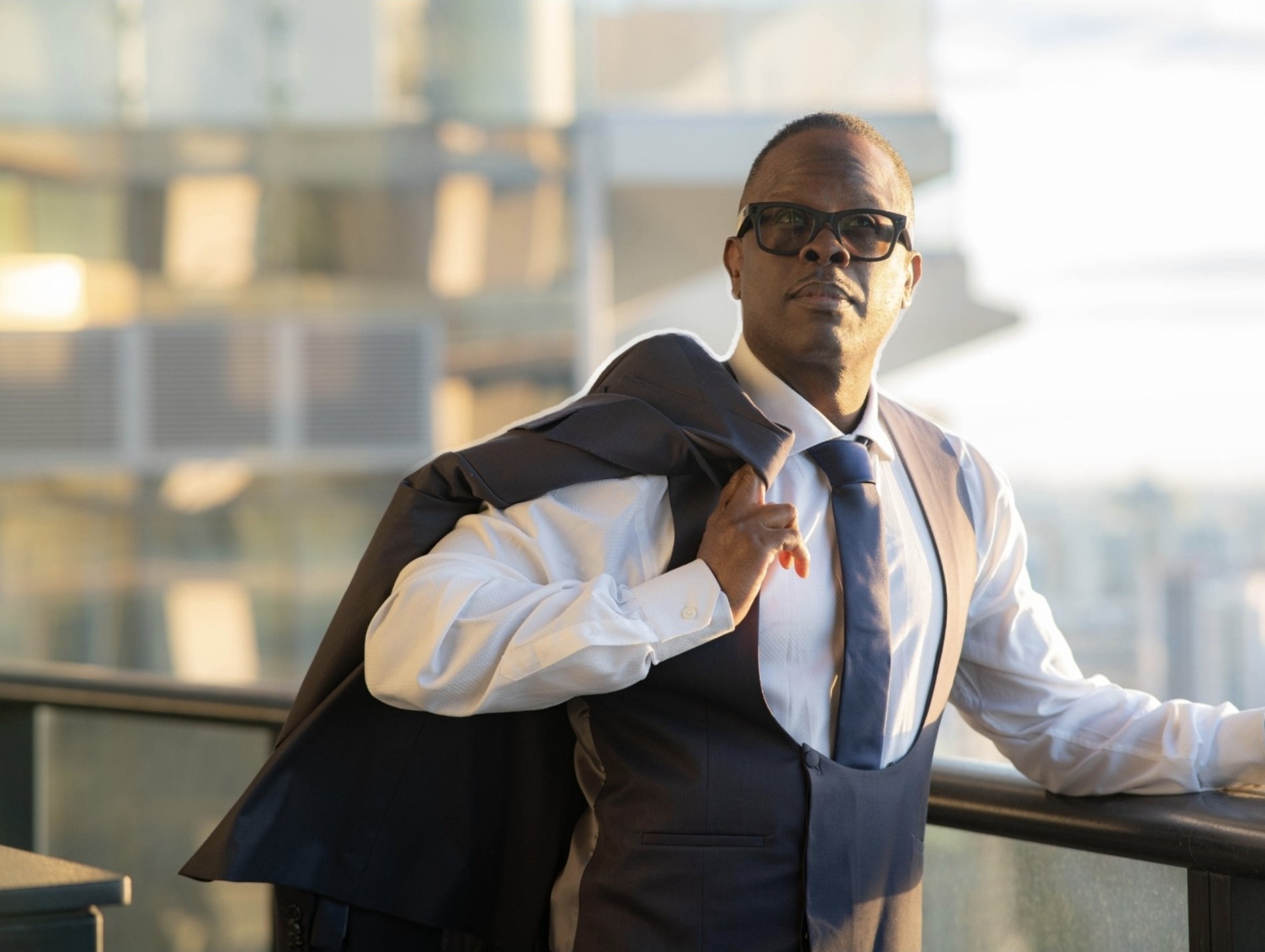
Dr. R Burton is the author of United States vs. US, Parts One and Two. His account: he wrote both while detained and deliberately kept his own case out on his attorney’s recommendation.
His account: he wrote both books while he was detained, and on his attorney’s strong recommendation he kept his own case out of them entirely, because anything he published about it could have been used against him while the case was still alive. The books could not be released until he was free. So the man wrote two books about the machine — the stacking, the jail, the vanished pleas of strangers — with his own chapter left blank on purpose.
“With personal experience navigating the complexities of federal prosecution, Dr. Burton brings both scholarly rigor and lived understanding to this work.”— United States vs. US, Part Two, About the Author — the books’ only allusion to his case
He was released July 24, 2026. House arrest ended Oct 24, 2026; supervised release continues. The missing chapter can finally be written — and this walk is where the book and the case meet.
Final Tease — What’s Not on This Page
YOU HAVEN’T HEARD ALL OF IT
What you just walked through is the public record — the part anybody can verify, filing by filing, line by line.
But the record is only the floor. It is not the ceiling.
“There is a whole lot I’m not going to share with you here, because I’m in talks with some of the biggest movie companies on planet Earth. Some of this story you’re just going to have to watch there.”— Rodney Burton
Names. Rooms. Conversations. Moments no docket will ever show. The fear. The pressure. The nights. The parts that explain how a licensing case became 933 days of a man’s life.
This page proves the paper. The movie will show the man.